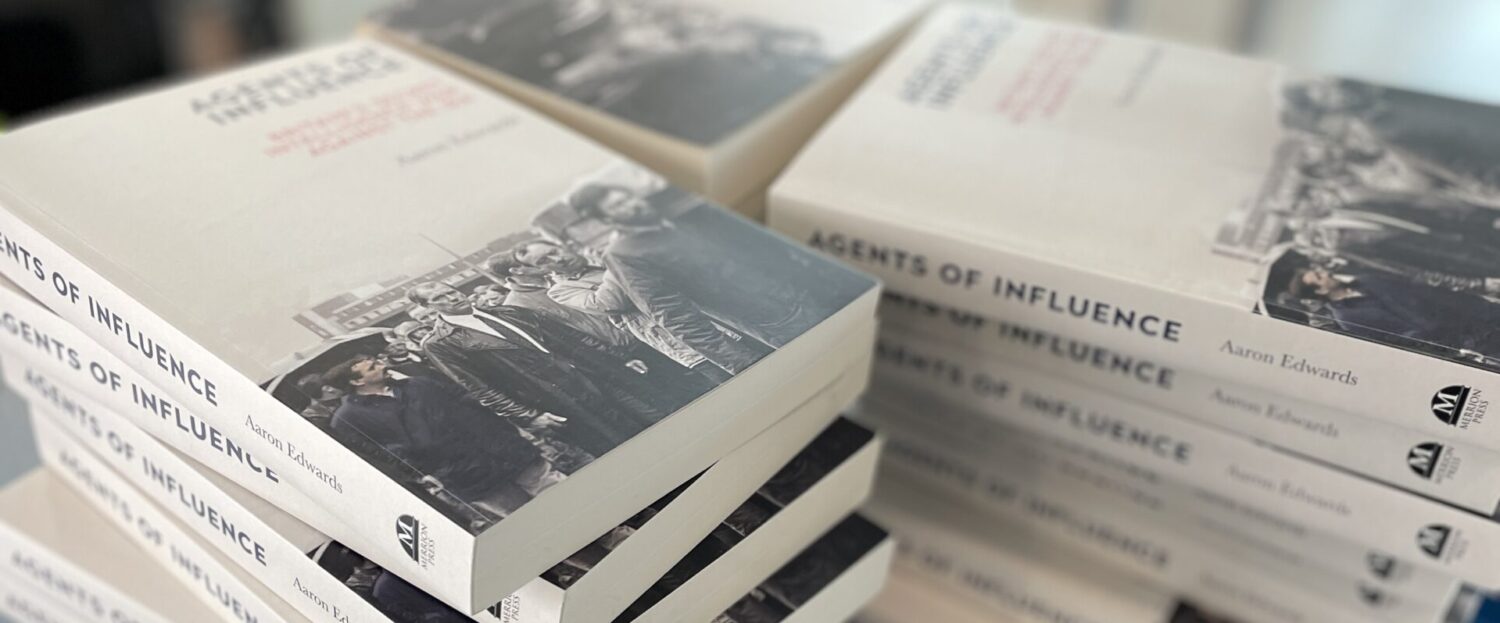

I republish below an excellent analysis by the late Henry McDonald of the central claims in my book, Agents of Influence, in The Sunday Times, 11 April 2021. It feels apt to republish this now after the revelations from the publication of the Op Kenova report.

Margaret Thatcher’s government had advance information on the IRA leadership’s decision-making in the 1980s, according to a book on Britain’s intelligence war in Northern Ireland.
Documents released under the Freedom of Information Act to author Aaron Edwards include Ministry of Defence (MoD) memos that indicate it knew of IRA intentions as soon as its army council met.
Agents of Influence also suggests that the “nutting” squad, an IRA unit to find informers, was run by John Joe Magee, a former Royal Marine turned terrorist. It had been thought the unit was controlled by Freddie Scappaticci, a Belfast man who has denied being the British agent Stakeknife.
“The leader of the squad for over a decade was Magee,” Edwards said. “Although from Belfast, he relocated withhis wife and family to a modest house in Dundalk. Most interrogations of suspected informers took place within a 15-mile radius of his home.”
It is estimated that at least 30 people accused of being informers were shot dead by the IRA unit.
Agents of Influence reports suspicions that Magee, now dead, was himself a British agent. Anthony McIntyre, an ex-IRA prisoner turned academic, recalls a conversation he had with Brendan Hughes, an IRA commander. “Hughes said JJ Magee was an informer and working for them [the British],” McIntyre is quoted as saying. “Hughes told me Magee’s flat . . . was bugged.”
Edwards quotes “Bob”, a senior RUC officer, who says that sources at the top of the IRA were passing on information. Bob said: “It was so sophisticated that we were reading the minutes of the IRA’s general army convention before they were disseminated to their senior membership.”
The author said MoD files bolster claims by “Bob” that by the mid-1980s the British had crucial insight into IRA decision-making. MoD reports from the UK national archives, all marked “Secret”, reveal the extent of the information. One report from 1983 says: “Intelligence suggests that the leadership intends to keep up pressure. Further attacks can be expected in Belfast and Derry using prestige weapons.”
Several documents focus on the rise of Gerry Adams within the IRA leadership. Following the Harrods bombing in 1983, in which six people died, security forces believe the leadership decided to avoid mass civilian casualties. “Intelligence points towards carefully targeted attacks rather than indiscriminate ones. Adams is clearly aware of how counter-productive politically such operations can be,” the report notes.